

The foundation your AI can trust
TensorLot Core is the layer between your sources and every model, assistant and agent: it reads what you have, scores it, helps you fix it — and serves the cleaned knowledge with citations. Nothing moves; nothing gets rewritten behind your back.
- Sources
- SharePoint · Confluence · Jira · GitHub
- Access
- read-only, permission-aware
- Output
- Tensor Bot · MCP / REST
- Hosting
- EU · private cloud on request
Connect your sources
- SharePoint, Confluence, Jira, GitHub
- Read-only, permission-aware
- Incremental sync — no migration
Score every document
- Health score per document
- Contradictions across sources
- Outdated & duplicate detection
Fix what’s broken
- Guided remediation
- Canonical version marked
- Rules per site, library or URL
Answer people and agents
- Cited answers via Tensor Bot
- One MCP endpoint for agents
- Every call audit-logged
TensorLot reads your document landscape where it lives. No migration, no copies to maintain: sites, libraries and site collections are synced incrementally and permissions come along from the source.
- SharePoint sites, libraries and site collections; Confluence, Jira, GitHub
- Read-only — TensorLot never writes to your sources
- Incremental sync, scoped per tenant and site collection
- Permissions mirrored from the source system
- SharePoint
- Confluence
- Jira
- GitHub
- Microsoft 365
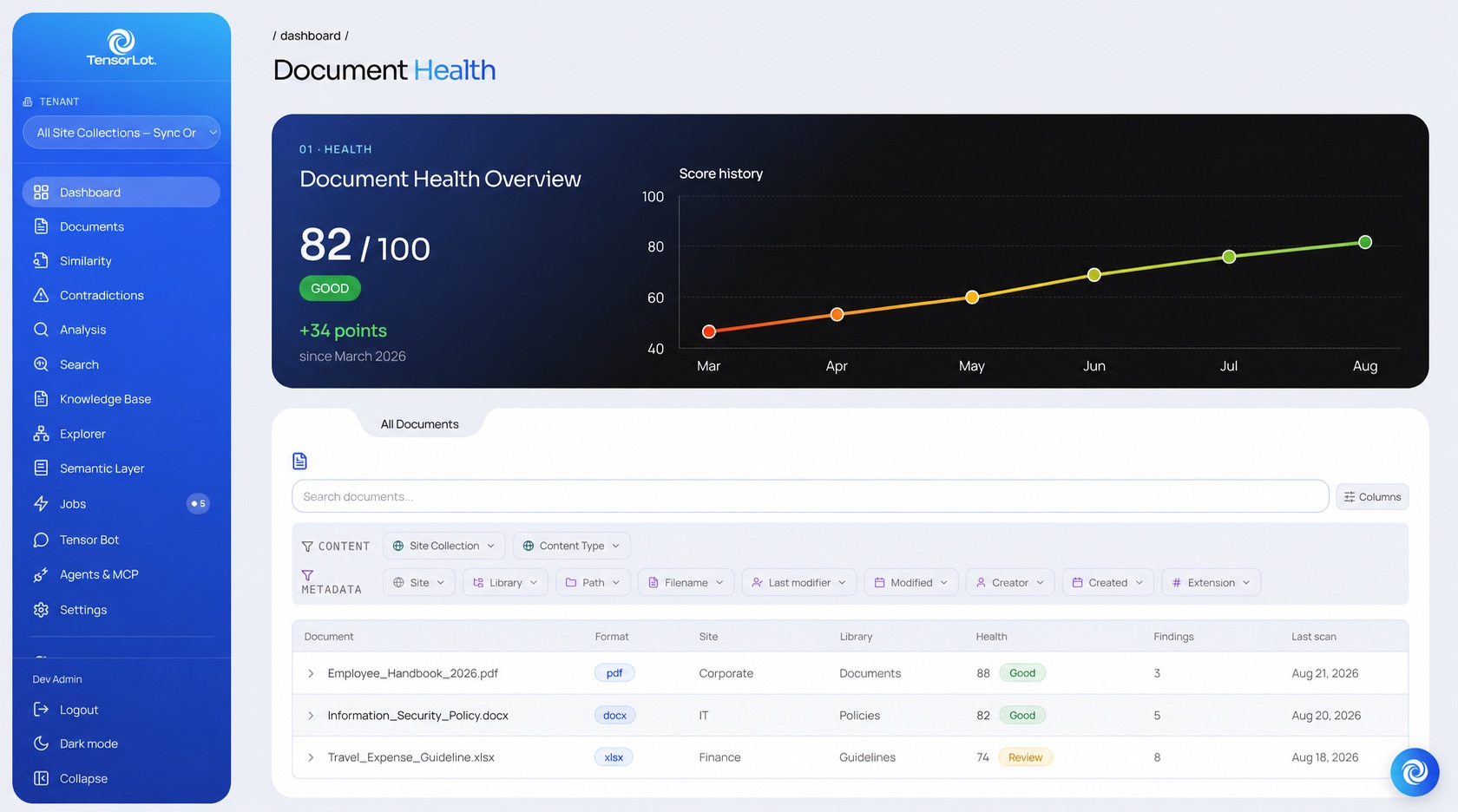
Every synced document with format, site, library, health, findings and last scan — filterable by content and metadata.
TensorLot Core reads your documents the way an auditor would: a health score per document and per tenant, contradictions across sources, outdated and duplicate copies — each as a finding with severity and the documents it affects.
- Health score per document (0–100) and for the whole tenant
- Contradictions across documents and sources
- Outdated content and duplicates, with the canonical candidate
- Findings with severity, status and affected documents
- Health score
- Contradictions
- Outdated
- Duplicates
- Findings
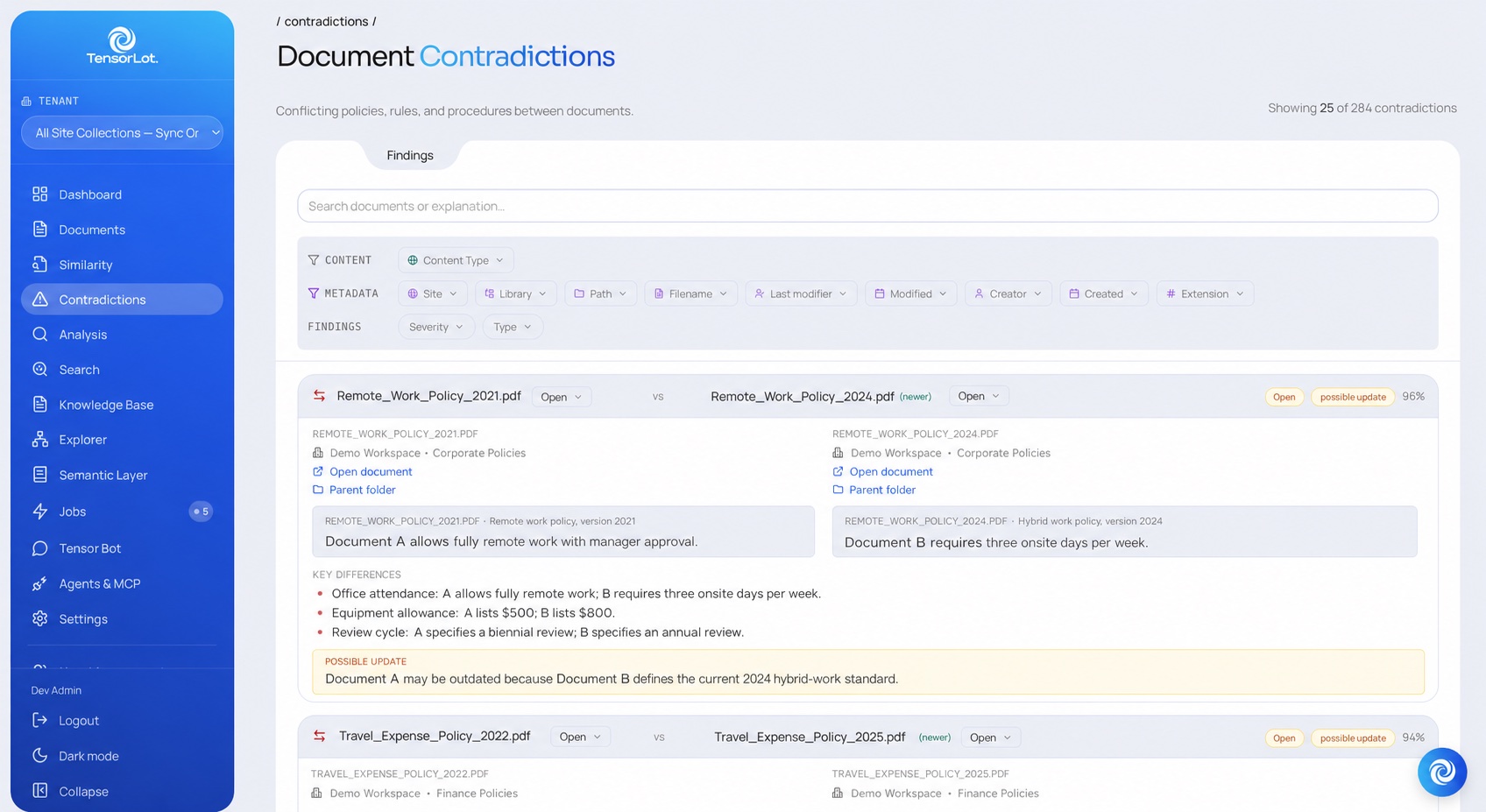
284 contradictions in this tenant — each pair side by side with the key differences, a confidence score and a verdict (“possible update: Document A may be outdated”).
Findings come with a recommended action. You decide once what “archive” or “resolve” means per URL prefix, library, site or tenant — most specific rule wins — and TensorLot hands the applicable instruction to the person or agent who acts with their own rights.
- Guided remediation per finding: resolve, archive, move, ignore
- Canonical version marked, duplicates pointed at it
- Action rules: URL prefix › Library › Site › Tenant default
- TensorLot never writes to SharePoint itself — actions stay with the user’s rights
- Resolved
- Archived
- Moved
- Ignored
- Action rules
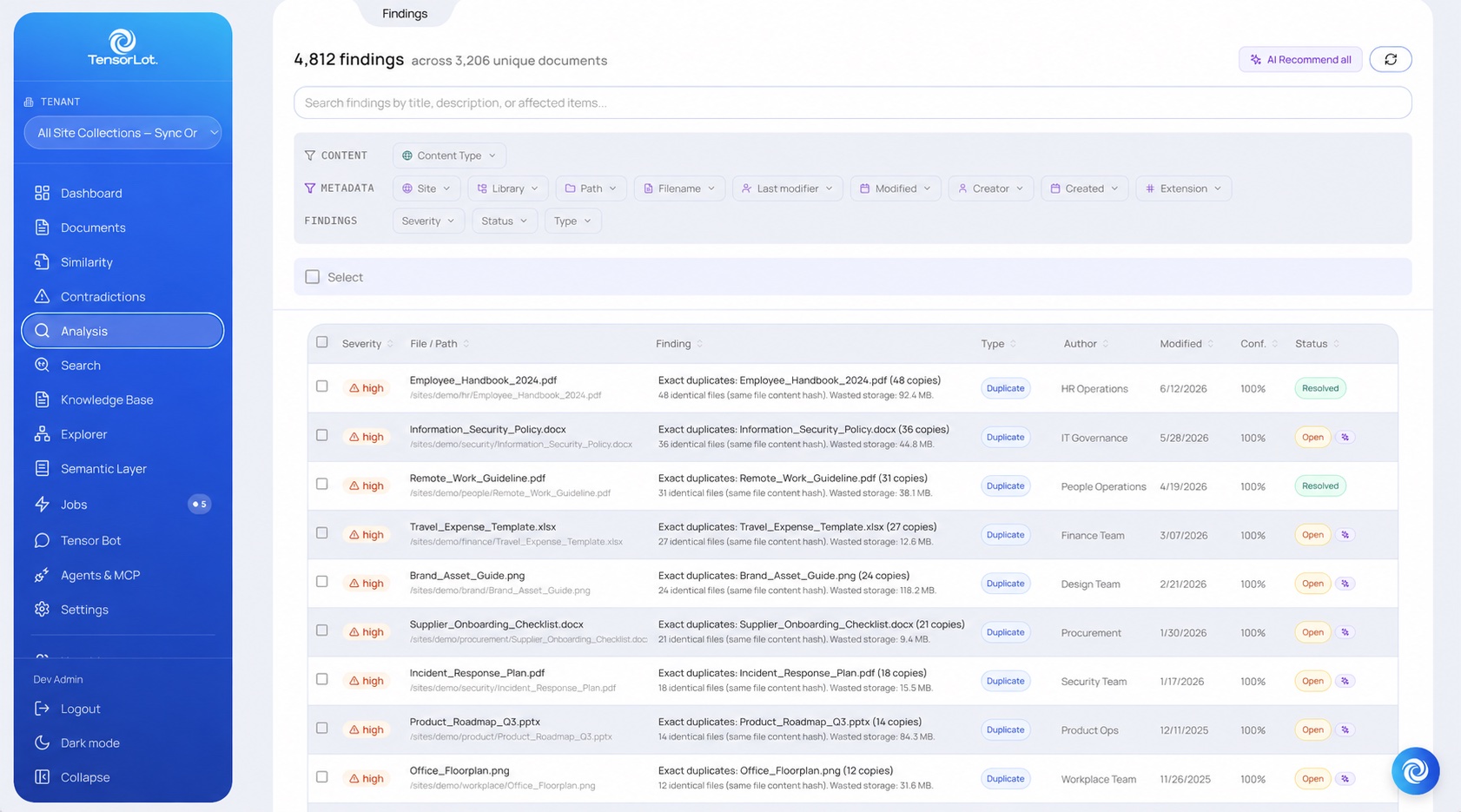
4,812 findings across 3,206 documents — severity, type, owner and status per finding; resolve one by one or let “AI Recommend all” propose the action.
The cleaned knowledge is served twice: to people through Tensor Bot, with every answer pointing at its sources, and to agents through one MCP endpoint — scoped, governed and audit-logged. On any model you choose.
- Tensor Bot: grounded answers with citations, scoped to a knowledge space
- MCP server: 11 governed tools, one endpoint, one key
- Every call logged with agent, tenant and tool
- Model- and platform-agnostic — Copilot Studio, Claude, OpenAI, your own
- Tensor Bot
- MCP
- REST
- Citations
- Audit log
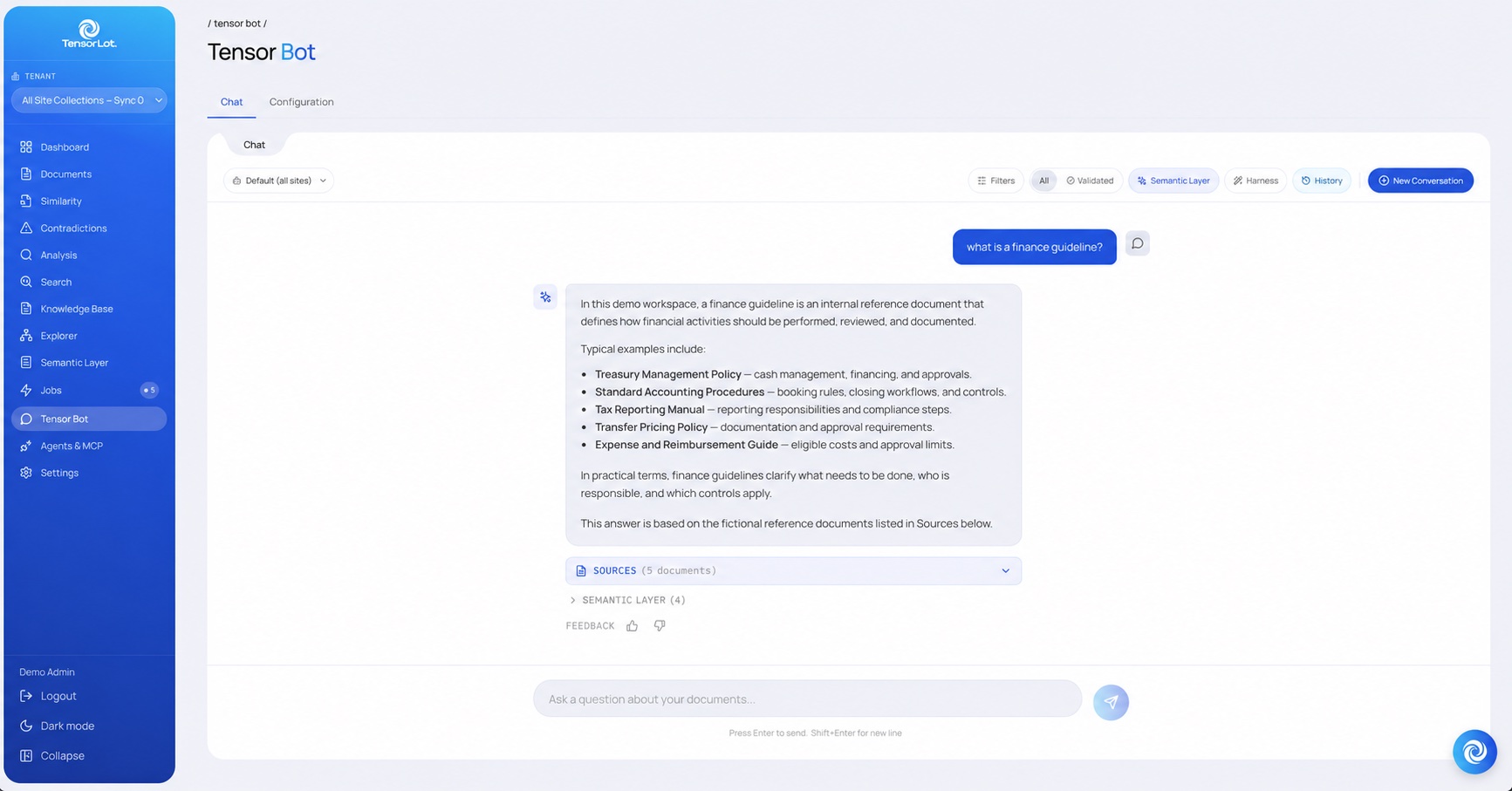
A grounded answer — and the 5 source documents it came from, one click away. Scoped per knowledge space, validated-only mode optional.
TensorLot is the layer in between — not another silo. Sources stay where they are; models and agent frameworks stay your choice.
A 30-minute demo on a sample of your SharePoint: health score, contradictions, and a cited answer — live.